



One of the first questions intended parents ask when considering surrogacy is:
How long does the entire surrogacy process take?
In the United States, a surrogacy journey often takes approximately 12–24 months or longer, depending on embryo readiness, surrogate availability, medical screening, legal requirements and pregnancy outcomes.
Some families move through certain stages quickly, while others need additional time for matching or IVF treatment.
Understanding the timeline can help intended parents prepare financially, emotionally and practically.
Here's a step-by-step look at what to expect in 2026.
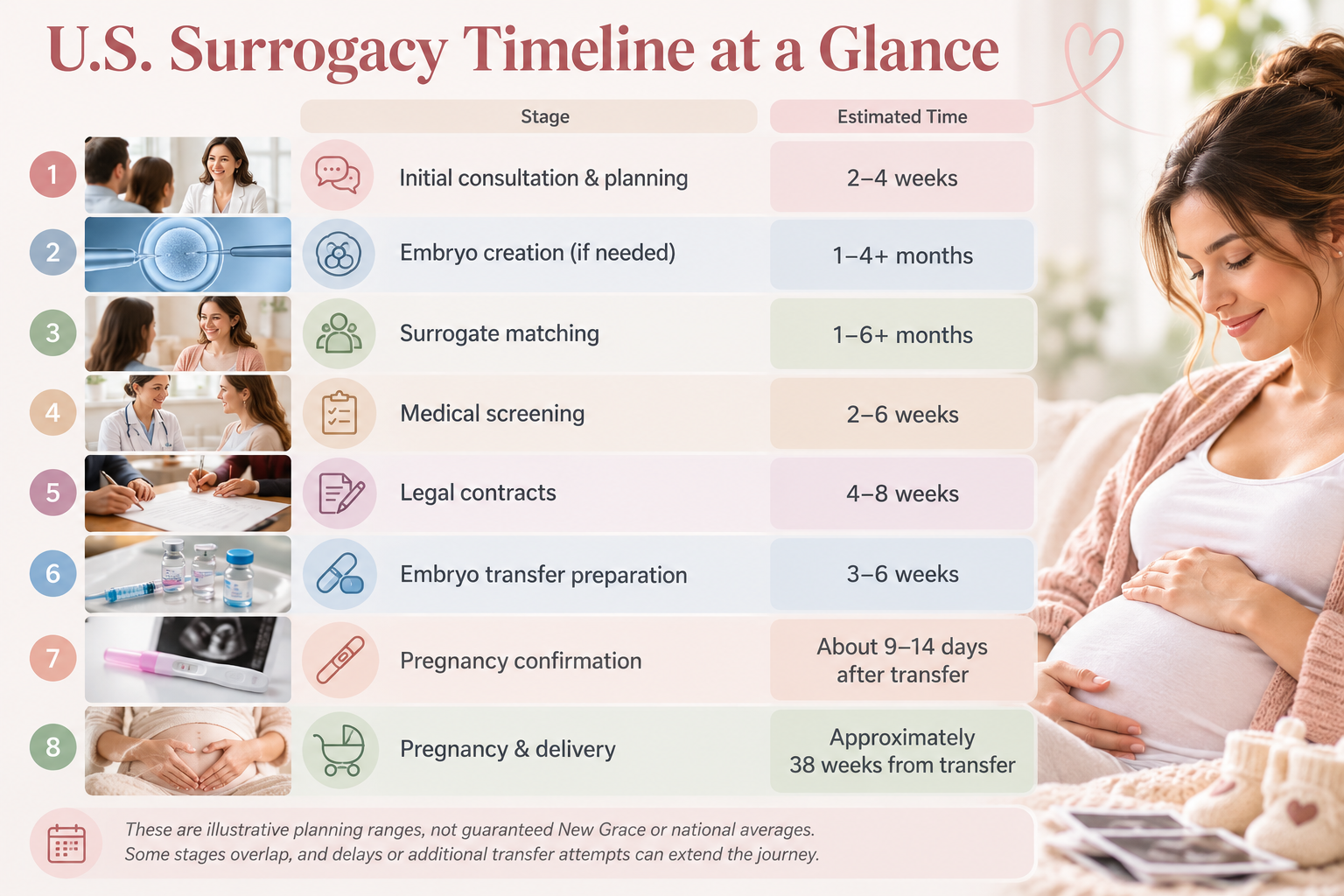
The journey usually begins with an initial consultation.
Intended parents discuss their family-building goals, fertility history, budget, location preferences and whether they already have embryos available.
For international intended parents, planning may also involve cross-border legal considerations, travel arrangements and coordination with a U.S. fertility clinic.
Tip: Having embryos ready before matching may help reduce waiting time later, although it does not guarantee a faster journey.
If intended parents do not already have embryos, they generally need to complete IVF first.
This may involve:
Egg retrieval or selecting an egg donor
Fertilization and embryo development
Genetic testing, when appropriate
Embryo freezing and storage
The timeline depends on donor availability, medical evaluations, laboratory procedures and individual IVF outcomes.
Families who already have suitable frozen embryos may be able to skip much of this stage.
Finding a compatible gestational surrogate is one of the most important stages.
The matching process typically considers:
Medical and pregnancy history
Communication preferences
Personal expectations
Location and availability
Compatibility with intended parents
Both sides should feel comfortable before moving forward.
Some matches happen quickly, while others take longer depending on candidate availability and individual preferences.
Once a match is established, the surrogate undergoes medical evaluation at the fertility clinic.
Screening may include reviewing previous pregnancy records, blood tests, infectious disease testing, uterine evaluation and psychological assessment.
According to the American Society for Reproductive Medicine (ASRM), gestational carriers should receive appropriate medical, infectious disease and psychosocial screening before treatment.
Additional tests or records may extend this stage.
Before embryo transfer, intended parents and their surrogate must complete the applicable legal requirements.
The agreement generally covers compensation, medical expenses, insurance, parentage, responsibilities and pregnancy-related expectations.
Each party should have independent legal representation.
ASRM recommends that the executed agreement, legal clearance and relevant informed consent documents be completed before treatment proceeds. State laws may impose additional requirements.
Legal coordination may overlap with certain administrative preparations, but transfer must wait until the required clearances are complete.
After the necessary clearances, the fertility clinic coordinates the embryo transfer cycle.
Depending on the protocol, this may involve:
Menstrual cycle scheduling
Estrogen or progesterone medications
Ultrasound monitoring
Bloodwork and hormone evaluation
Final embryo transfer scheduling
Once the clinic confirms that the surrogate is ready, the embryo transfer can proceed.
A pregnancy blood test is usually scheduled approximately 9–14 days after transfer, depending on clinic protocol.
If the transfer does not result in pregnancy, another cycle may be needed, extending the overall timeline.
After pregnancy is confirmed, the surrogate continues prenatal care under her medical team.
Throughout pregnancy, intended parents may receive ultrasound updates, communicate with their surrogate and coordinate with the surrogacy team.
Important milestones may include:
Early pregnancy ultrasound
Routine prenatal visits
Anatomy scan
Parentage-related legal procedures
Hospital and delivery planning
International intended parents may also need to arrange travel, newborn documentation and return-home requirements.
The actual delivery date can vary, and some pregnancies require additional medical care.
Even a well-organized journey may encounter unexpected delays.
Common factors include limited surrogate availability, additional medical screening, donor or embryo preparation, legal documentation, unsuccessful embryo transfers, pregnancy loss or scheduling conflicts.
For international families, documentation and travel logistics may require additional planning.
Because these factors vary, intended parents should treat any estimated timeline as a planning guide rather than a guaranteed completion date.
Yes. Many early stages can often be coordinated remotely.
For example, international intended parents may be able to complete initial consultations, review surrogate profiles, attend matching calls and receive pregnancy updates online.
However, medical requirements, legal documentation, hospital procedures and newborn travel arrangements may require in-person participation or additional coordination.
Planning these requirements early can help avoid preventable delays.
Some portions of the process can move quickly, especially when embryos are ready and matching happens promptly. However, pregnancy alone takes approximately nine months, so completing an entire journey in under 12 months is not something intended parents should assume.
It can reduce the time required for IVF preparation, but surrogate matching, screening, legal clearance and transfer preparation are still necessary.
Matching may take weeks or several months or longer, depending on candidate availability and compatibility. No fixed timeframe applies to every family.
The fertility clinic will review the outcome and determine whether another transfer is appropriate. Additional attempts can extend the overall timeline.
So, how long does surrogacy take in the U.S.?
A planning estimate of 12–24 months or longer can help intended parents understand the overall journey, but actual timing depends on their circumstances.
At New Grace, we help intended parents navigate the process—from surrogate matching and medical screening to legal coordination, embryo transfer, pregnancy and delivery.
Whether you're starting IVF or already have frozen embryos, understanding each stage is an important first step toward planning your family-building journey.
This article is for informational purposes only and does not constitute medical or legal advice. Timelines are illustrative estimates rather than guaranteed outcomes. Consult your fertility clinic and qualified reproductive attorneys regarding your circumstances.
New Grace Fertility | Asian Family Surrogacy Inc.
📧 Email: info@newgracefertility.com
🌐 Website: www.cneggbank.com|www.newgracefertility.com