



One of the most common questions intended parents ask is:
"Should we create and freeze our embryos before we begin looking for a surrogate?"
For many families, the answer is yes.
In fact, many fertility clinics recommend completing the IVF and embryo creation process before matching with a gestational carrier. Doing so can make planning easier, reduce delays, and give intended parents a clearer understanding of their reproductive options.
This guide explains why embryo freezing is often recommended, when it makes sense, and what you should know before starting your surrogacy journey.
A gestational surrogacy journey involves several important steps, including IVF treatment, legal agreements, medical screening, and embryo transfer.
Creating embryos before beginning surrogate matching offers several advantages:
Many agencies and fertility clinics find that having embryos ready before matching helps streamline the overall journey.
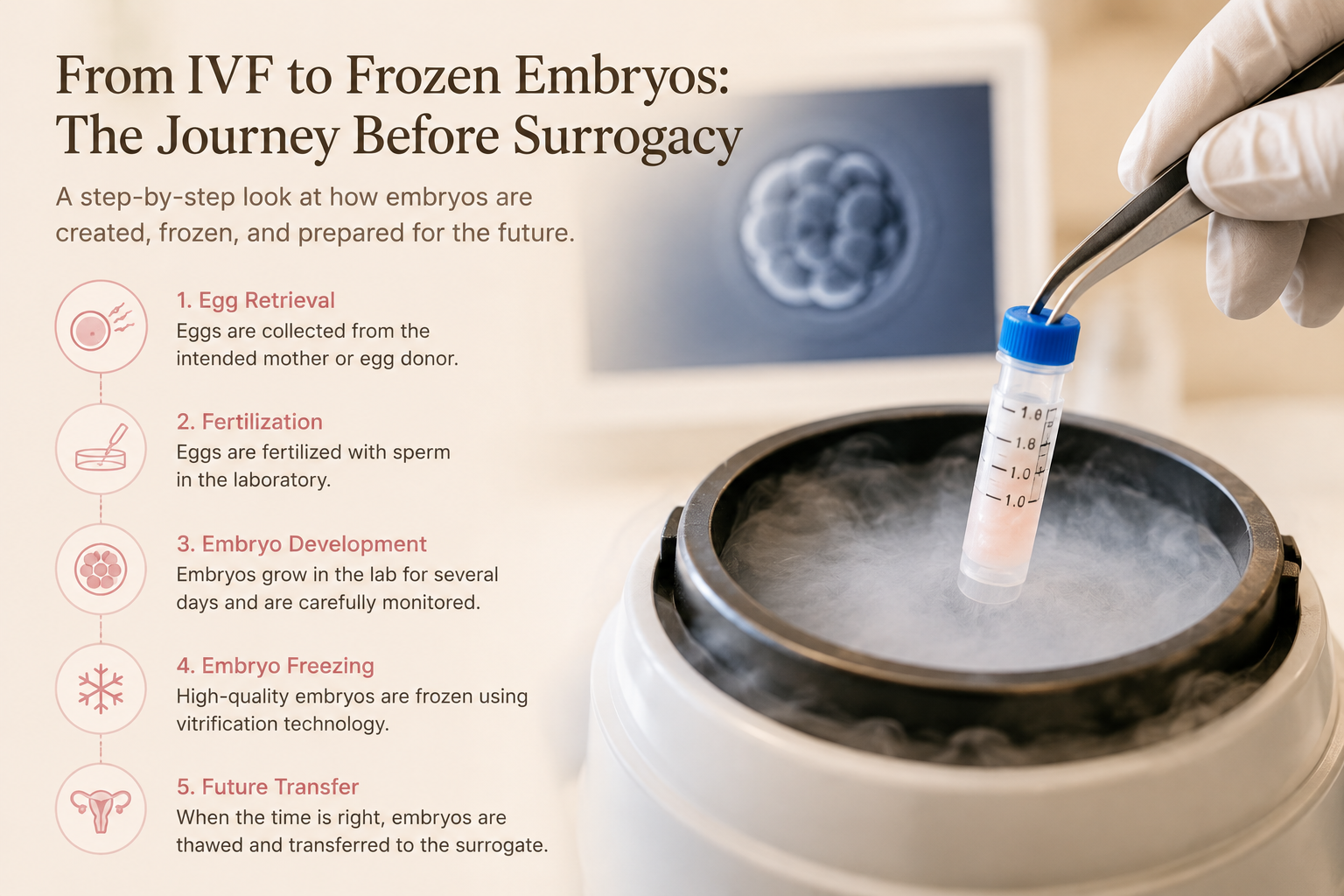
Embryo freezing, also called embryo cryopreservation, is the process of preserving embryos using rapid freezing technology (vitrification).
After IVF:
When you're ready, the embryos are thawed and transferred into the uterus of the intended mother or a gestational surrogate.
Modern vitrification techniques have made frozen embryo transfer a routine part of IVF treatment, with success rates that are comparable to or, in many clinics, even better than fresh transfers due to improved cycle preparation. Current ASRM guidance supports vitrification as the standard method for embryo cryopreservation.
Having embryos already created allows your fertility team to coordinate the surrogate's medical schedule more efficiently.
If legal paperwork, surrogate matching, or travel takes longer than expected, your embryos remain safely preserved.
Instead of coordinating IVF stimulation and surrogate preparation simultaneously, each step can proceed independently.
Knowing:
can help you make more informed decisions before beginning the transfer process.
This is one of the biggest misconceptions.
Many intended parents worry that frozen embryos are somehow "less healthy."
Fortunately, decades of research suggest otherwise.
With modern vitrification techniques, frozen embryo survival after thawing is extremely high, and pregnancy outcomes are comparable to fresh embryo transfers in appropriate patients.
Today, frozen embryo transfer (FET) has become the standard approach at many leading fertility clinics around the world.
Some intended parents also consider Preimplantation Genetic Testing (PGT).
PGT may help identify embryos with the correct number of chromosomes before transfer.
Depending on your age and medical history, your fertility specialist may recommend:
Whether PGT is appropriate depends on your individual fertility goals and should be discussed with your physician.
One of the biggest advantages of embryo freezing is flexibility.
Frozen embryos can typically remain cryopreserved for many years without meaningful loss of viability when stored under appropriate laboratory conditions.
This allows intended parents to:
Embryo storage policies and annual storage fees vary by clinic.
Many fertility specialists recommend completing embryo creation before beginning surrogate matching.
A common sequence is:
IVF consultation
Egg retrieval (or donor egg cycle)
Embryo creation
Optional PGT
Embryo freezing
Begin surrogate matching
Legal contracts
Frozen embryo transfer
This sequence often reduces scheduling conflicts and helps intended parents move through the process more efficiently.
Embryo freezing offers many advantages, but it may not be the best option for every family.
Potential considerations include:
Your fertility clinic can help you determine the most appropriate treatment plan based on your specific situation.
Yes.
However, many agencies and clinics recommend having embryos available before matching, as this can simplify scheduling and reduce delays.
Yes.
Embryos stored under proper cryopreservation conditions may remain viable for many years.
Not necessarily.
Embryos can be created using:
The best approach depends on your fertility diagnosis and treatment goals.
Freezing embryos before beginning surrogacy provides many intended parents with greater flexibility, clearer treatment planning, and a more efficient overall journey.
Although every family's situation is unique, creating embryos first often helps reduce uncertainty and allows medical, legal, and matching processes to move forward more smoothly.
Discuss your options with an experienced fertility specialist to determine the approach that best fits your family's needs.
At New Grace, we help intended parents around the world navigate every stage of the surrogacy journey—from IVF planning and embryo creation to surrogate matching and birth.
Our team provides support with:
Whether you're just beginning IVF or preparing for embryo transfer, we're here to help you build your family with confidence.
👉Schedule a Consultation Today
👉Learn More About Our Surrogacy Program
👉Speak with Our International Team
This content is provided for informational purposes only and should not be considered medical advice. Fertility treatment decisions should always be made in consultation with a qualified reproductive endocrinologist based on your individual medical history and treatment goals.
New Grace Fertility | Asian Family Surrogacy Inc.
📧 Email: info@newgracefertility.com
🌐 Website: www.cneggbank.com|www.newgracefertility.com